|
|||||||||
| |||||||||
| 2006 Benjamin Franklin Award Finalist |









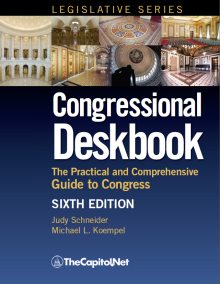
This comprehensive guide to Congress is ideal for anyone who wants to know how Congress really works, including federal executives, attorneys, lobbyists, media and public affairs staff, government affairs, policy and budget analysts, congressional office staff and students.
- Clear explanation of the legislative process, budget process, and House and Senate business
- Flowcharts for legislative and budget processes
- Explanation of the electoral college and votes by states
- Glossary of legislative terms
- Relationship between budget resolutions and appropriation and authorization bills
- Amendment tree and amendment procedures
- How members are assigned to committees
- Agenda for early organization meetings (after election, before adjournment)
- Sample legislative documents with explanatory annotations
- Bibliographic references throughout
| More Information | ||||
| Table of | The Authors | Related | Documents and Resources Referenced in the Congressional Deskbook var addthis_brand = "TheCapitol.Net"; | § 6.01 Legislative Process Flowchart |
As the name Congressional Deskbook implies, this book is meant to be kept close at hand for answering the variety of questions that arise daily in monitoring, interacting with, and studying Congress. The book is organized for daily use in answering questions, but it may be read in sections, by chapters, or in its entirety, as the reader chooses.
The sixth edition was extensively revised to reflect significant changes on Capitol Hill since the fifth edition and also to reflect changes in Deskbook readers' needs and their suggestions. We revised and reorganized chapters. For example, Chapter Three was completely rewritten to present the extensive changes in lobbying and ethics laws in the last several Congresses, providing the government relations professional with the necessary information to interact with counsel in planning and implementing government relations activities, and providing government relations professionals and members of Congress and congressional staff alike with essential information on the ethics regime in which representatives and senators work.
Regarding changes in Deskbook readers' needs and their suggestions, when we wrote the first edition of this book in 1999, the World Wide Web was still new and print was still the dominant source of congressional information. Government relations tools online and software were still taking shape, and congressional offices still dealt largely with paper letters, documents, and records. Webcasting was unknown on Capitol Hill. That was then. Today, the congressional information world and online government relations management is technologically much more sophisticated, and congressional offices work largely in an electronic environment, with few items still existing exclusively in print. Most importantly, Deskbook readers are savvy and sophisticated workers in this electronic environment. We no longer perceived a need for the chapter on private and government information providers and electronic research tips found in previous editions of the Deskbook, and dropped it from the sixth edition We reorganized monitoring information in the Deskbook, so that, for example, key components of former chapters on the Capitol complex and on monitoring and researching Congress were combined in a new, targeted Chapter Eleven on Viewing and Visiting Congress.
Chapter One attempts to create an image of what it is like to be a member of Congress. It describes the competition that imbues every aspect of the institution and the fragmented life of a member.
Chapters Two and Three guide the reader through some of the major pressures affecting members of Congress. These pressures come from campaigns and elections, lobbyists, and the ethics environment. The chapters provide an overview of the laws and congressional rules that affect members, staff, and the individuals who interact with them.
Chapter Four explains the support structure of Congress. It identifies components of the expense allowance system, staff positions and responsibilities, and the work of support offices. This chapter orients the reader to congressional staff roles.
Chapter Five describes the organization of Congress. It addresses not only the structures of the committee system and of the leadership hierarchy, but also how committee assignments are made and leaders are selected. It describes the early organization activities of the House and Senate following a general election.
Chapter Six describes the legislative process in detail. It explains hearings and committee markup strategies and methods of obtaining floor consideration of legislative initiatives. Amendments between the chambers and conference procedures are explained. The chapter describes options available to leaders and members throughout the legislative process.
Chapter Seven demystifies the federal budget process. It includes discussion of the president's role in budgeting, the congressional budget process, authorizations, and appropriations. It explains the terminology, concepts, and procedures of the budget process, such as reconciliation.
Chapter Eight discusses procedures and powers in Congress's relations with the executive, the judiciary, and the states and localities. It also explains some of the ways in which Congress deals procedurally with defense and foreign policy. Topics in this chapter include confirmation of presidential appointees to executive and judicial posts, the role of legislative history, fast-track procedures, the War Powers Act, alternative procedures for selection of a president and vice president, constitutional amendments, and unfunded mandates.
Chapters Nine and Ten identify and explain the use of congressional documents. Subjects include the forms and versions of legislation, laws and implementing executive documents, official rules and procedure manuals, and party and administrative publications.
Chapter Eleven guides the reader in viewing the House and Senate in session on C-SPAN, and also guides the reader around Capitol Hill so that the visitor might orient herself before a trip to the Capitol or one of the congressional office buildings. This chapter also includes a checklist for tracking legislative action and tips on communicating with members and committees and their staffs.
A case study in Chapter Twelve ties the legislative process, legislative documents, and other topics in the book together as it takes a measure enacted into law in the 106th Congress through the legislative steps from inception to public law. Document excerpts are displayed, and explanatory texts and annotations accompany each excerpt.
A cumulative, expanded glossary complements the individual glossaries and definitions that appear in individual chapters. All of the web sites listed throughout the book are cumulated in a table. This list is followed by an index to the book.
From the Introduction
Summary of Contents
Introduction
Chapter 1. Being a Member of Congress
Chapter 2. Pressures on Congress: Campaigns and Elections
Chapter 3. Pressures on Congress: Lobbying and Congressional Ethics
Chapter 4. Supporting Congress: Allowances and Staff
Chapter 5. Organizing Congress: Members, Leaders, and Committees
Chapter 6. Legislating in Congress: Legislative Process
Chapter 7. Legislating in Congress: Federal Budget Process
Chapter 8. Legislating in Congress: Special Procedures and Considerations
Chapter 9. Congressional Documents: Overview, Legislation, and Laws
Chapter 10. Congressional Documents: Committee, Chamber, Party, and Administrative Publications
Chapter 11. Legislative Research: Viewing and Visiting Congress
Chapter 12. Putting It All Together: A Working Example
Back of the Book
Glossary *
Table of Web Sites
Principal Index Terms
Index
Table of Contents
* = online link
Acknowledgments
About the Authors
Preface
Introduction
Chapter 1. Being a Member of Congress
1.00 Introduction
1.10 Who . . . Gets . . . What!
1.20 Congress, the Political Institution
1.30 A Member of Congress as Politician, Policymaker, and Parliamentarian
1.40 Obligations and Perquisites
1.50 Ever-Changing and Unpredictable Schedules
1.51 Example of a Senior House Member's Daily Schedule
1.52 Example of a Freshman House Member's Daily Schedule
1.53 Excerpt from House's Daily Schedule (GOP Source)
1.54 Excerpt from House's Daily Schedule (Democratic Source)
1.55 Floor Discussion of Schedule Changes
1.60 Family Life
1.70 Staying in Congress
1.80 Chapter Summary and Discussion Questions
Chapter 2. Pressures on Congress: Campaigns and Elections
2.00 Introduction
2.10 Campaigns and Elections
2.11 2012 and 2014 Congressional Election Information
2.12 Members' Support for Candidates
2.20 Constituency Pressure
2.21 Examples of Constituent Outreach
2.22 Example of Member's Newsletter or Report
2.23 Example of Privacy Act Release Form
2.24 Constituent Service Reflected in Member's Newsletter
2.25 Case Work Outreach
2.26 Assistance to Constituents
2.27 Tips for Contacting Members of Congress *
2.28 Addressing Correspondence to Members of Congress *
2.29 Constituent Outreach Meetings
2.30 Advertising Constituents' Access to a Member
2.31 Example of Community Holiday Event
2.32 Internship Opportunities in a Congressional Office
2.40 Reapportionment and Redistricting
2.41 Change in States' Population and Seats in the House of Representatives
2.50 Term Limits
2.60 Election Challenges
2.70 Federal Campaign Finance Laws
2.80 Federal Campaign Finance-Related Laws and Rules
2.90 Laws Protecting and Extending the Franchise
2.100 Chapter Summary and Discussion Questions
Chapter 3. Pressures on Congress: Lobbying and Congressional Ethics
3.00 Introduction
3.10 Lobbying Pressures
3.20 Congress as an Open Institution
3.21 Grassroots Training
3.22 Example of Grassroots Campaign
3.23 Meeting Tips for a Lobbyist
3.30 Lobbying Laws
3.40 Factors Affecting Application of Laws and Rules
3.41 Lobbying Registration Form
3.50 Congressional Ethics
3.60 Regulated Activities
3.61 House and Senate Financial Disclosure Form
3.70 Chapter Summary and Discussion Questions
Chapter 4. Supporting Congress: Allowances and Staff
4.00 Introduction
4.10 Pay and Allowances of Members *
4.20 Salary, Earned Income, and Benefits *
4.30 House Allowances for Staff, Office, and Other Expenses
4.40 Senate Allowances for Staff, Office, and Other Expenses
4.41 Senators' Official Personnel and Office Expense Account
4.50 Franking Privilege
4.60 Personal Staff
4.61 Staff Salary Data
4.62 Congressional Staff Organizations
4.70 Committee and Subcommittee Staff
4.80 House of Representatives Committee Funding
4.90 Senate Committee Funding
4.100 Congressional Fellowships and Internships *
4.110 Administrative Offices of the House
4.111 Chaplains and Guest Chaplains
4.112 Selling Products and Services to Congress
4.113 Congressional Pages
4.114 Capitol Security
4.120 Administrative Offices of the Senate
4.121 Architect of the Capitol
4.122 Office of the Attending Physician
4.123 Capitol Police
4.130 Legislative-Branch Support Agencies
4.131 Requesting GAO Assistance
4.140 Government Printing Office
4.150 Congressional Accountability Act
4.160 General Services Administration
4.170 Congressional Liaison Offices
4.171 Liaison Offices on Capitol Hill
4.172 Duties of a Congressional Liaison Office
4.173 General Counsel Offices
4.180 Office of Management and Budget
4.190 National Archives and Record Administration
4.200 Outside Groups
4.201 Congressional Spouse Organizations
4.210 Chapter Summary and Discussion QuestionsChapter 5. Organizing Congress: Members, Leaders, and Committees
5.00 Introduction
5.01 Constitutional Provisions Related to the Composition and Organization of Congress
5.10 Members of Congress: Service, Qualifications, Characteristics, and Filling Vacant Seats
5.11 Senate Classes
5.12 Membership Changes, 112th Congress, First Session
5.13 Party Switchers
5.14 Selected Characteristics of the 112th Congress
5.15 Senators in the 112th Congress Who Previously Served in the House of Representatives
5.16 Former Governors Serving in the 112th Congress
5.17 Numbers of Former State and Local Elected Officials Serving in the 112th Congress
5.18 Members of Congress Who Subsequently Served on the Supreme Court
5.19 Former Judges Serving in the 112th Congress
5.20 Members of the 112th Congress Who Were Pages
5.21 Delegates in the House of Representatives
5.22 Members of the 112th Congress Who Have Served as Congressional Staff
5.23 Vice Presidents Elected to Senate
5.30 Terms and Sessions of Congress
5.31 Terms of Congress *
5.32 Lame-Duck Sessions of Congress, 1935-2010
5.33 Resume of Congressional Activity, 111th Congress
5.34 Joint Meetings and Joint Sessions
5.40 Early Organization Meetings
5.41 Representative Early Organization Schedule: 108th Congress
5.50 Party Leadership
5.51 Party Control of Congress, 80th through 112th Congresses
5.60 House Leadership *
5.61 The Parties' Whip Structures
5.70 Senate Leadership *
5.80 Committees and Subcommittees
5.81 House and Joint Committee Ratios in the 112th Congress *
5.82 Senate Committee Ratios in the 112th Congress *
5.90 Committee Leadership
5.91 House Committee Chairs and Ranking Minority Members and Their Tenure
5.92 Senate Committee Chairs and Ranking Minority Members and Their Tenure
5.100 House Committee and Subcommittee Assignment Process
5.101 Member Press Release
5.102 Example of a Senior Committee Member's Activities
5.103 House Committee Assignment Request Form
5.104 Categories of Committees in the House of Representatives
5.110 Senate Committee and Subcommittee Assignment Process
5.111 Categories of Committees in the Senate
5.120 Informal Groups and Congressional Member Organizations (CMOs)
5.121 Selected Caucuses and Informal Groups
5.130 Commissions and Boards
5.140 Chapter Summary and Discussion Questions
Chapter 6. Legislating in Congress: Legislative Process
6.00 Introduction
6.01 Legislative Process Flowchart *
6.02 House Rules Citations
6.03 Senate Rules Citations
6.04 Selected Procedures: House and Senate Rules
6.10 Types of Measures
6.11 Legislation Glossary
6.20 Drafting and Introducing Legislation
6.21 House Cosponsorship Form
6.22 Sample "Dear Colleague" Letter
6.30 Referral of Legislation to Committee
6.31 Sample Jurisdictional Agreement
6.32 Sample of House Referral
6.40 Committee Hearings
6.41 Committee Hearings Schedule
6.42 Sample Truth in Testimony Form
6.43 Celebrity Witnesses
6.44 Field Hearing Announcement
6.50 Committee Markup
6.51 Committee Markup and Reporting Glossary
6.60 Committee Reports
6.61 Reading the Cover Page of a House Committee Report
6.62 House Committee Reports: Required Contents
6.63 Senate Committee Reports: Required Contents
6.70 House Floor: Scheduling and Privilege
6.71 House Calendars
6.72 Daily Starting Times in the House
6.80 House Floor: Methods of Consideration
6.81 Discharge Petition
6.90 Rules Committee and Special Rules
6.91 Special Rules Glossary
6.92 Request for Special Rule
6.93 Announcement on Amendments Prior to a Rules Committee Meeting
6.94 Reading a Special Rule
6.100 Consideration of a Special Rule on the House Floor
6.110 Committee of the Whole: Debate
6.111 The Mace
6.112 House versus Committee of the Whole
6.113 Who Is Allowed on the House Floor?
6.114 Committee of the Whole and the House: Stages of Action
6.120 Committee of the Whole: Amendment Process
6.121 Amendment Process Glossary
6.122 Basic House Amendment Tree
6.130 House Floor: Voting
6.131 House Voting Glossary
6.140 House Floor: Motion to Recommit and Final Passage
6.141 Approval Terminology
6.150 House and Senate Compared
6.151 Comparison of Selected House and Senate Procedures
6.160 Senate Scheduling
6.170 Legislative and Calendar Days; Morning Hour and Morning Business
6.180 Senate Calendars and Legislative and Executive Business before the Senate
6.190 Holds, Clearance, and Unanimous Consent
6.191 Senator's Notice of Hold or Desire to be Consulted
6.192 Who Is Allowed on the Senate Floor?
6.200 Time Agreements and Motions to Proceed on the Senate Floor
6.201 Example of a Senate Unanimous Consent Time Agreement
6.202 Comparing a House Special Rule and a Senate Time Agreement
6.210 Consideration and Debate on the Senate Floor
6.211 Longest Senate Filibusters
6.220 Senate Amendment Procedure
6.230 Cloture in Senate Floor Proceedings
6.231 Steps to Invoke Cloture
6.232 Senate Procedures under Cloture
6.240 Senate Floor: Motion to Reconsider and Final Passage
6.250 Voting in the Senate
6.260 Reconciling Differences between House-Passed and Senate-Passed Legislation
6.261 Reconciling Differences Glossary
6.270 Amendments between the Houses
6.280 Conference Committees
6.281 Size of Conference Committees
6.282 Authority of Conferees
6.283 Authority of Conference Signature Sheet
6.290 Presidential Action on Enacted Measures
6.291 Signing Statement
6.292 Vetoes and Veto Overrides: Presidential Clout
6.300 Publication of Public Laws
6.310 Chapter Summary and Discussion Questions
Chapter 7. Legislating in Congress: Federal Budget Process
7.00 Introduction: Congress's "Power of the Purse"
7.01 Congress's Constitutional "Power of the Purse"
7.02 Federal Budgeting Concepts and Terminology
7.10 Key Budget Process Laws
7.11 Budget Enforcement Act Procedures: 1990-2002
7.11 Statutory PAYGO Act of 2010
7.20 The Budget Cycle
7.30 Budget Enforcement Framework
7.40 Presidential Budget Process
7.41 Executive Budget Process Timetable
7.42 Office of Management and Budget Publications for Agencies
7.43 Volumes Containing and Explaining the President's Annual Budget
7.44 Program and Financing Schedule in President's Budget Appendix
7.50 Congressional Budget Process
7.51 Congressional Budget Process Timetable
7.52 Completion Dates of Budget Resolutions
7.53 Congressional Budget Process Flowchart
7.54 Functional Categories in a Congressional Budget Resolution
7.55 Membership on the House and Senate Budget Committees
7.60 Spending, Revenue, and Debt-Limit Legislation
7.61 Budgeting for Direct and Guaranteed Loans
7.70 Spending Legislation
7.71 Differences between Discretionary and Direct Spending
7.80 Authorizations and Appropriations Processes
7.81 Limitations, Earmarks, and General Provisions
7.82 New Appropriations Subcommittee Organization
7.83 Sequence of Appropriations Measures through Congress
7.84 Examples of Appropriations Subcommittees' Requirements for Member Requests
7.90 Revenue Legislation
7.91 Tax Expenditures
7.92 Revenue Estimates
7.100 Debt-Limit Legislation
7.110 Reconciliation Legislation
7.120 Implementation of the Budget by Executive Agencies
7.130 Apportionment
7.140 Transfer and Reprogramming
7.150 Impoundment: Deferrals and Rescissions
7.160 Budget Process Glossary
7.170 Chapter Summary and Discussion Questions
Chapter 8. Legislating in Congress: Special Procedures and Considerations
8.00 Introduction: Separation of Powers, Checks and Balances, and Federalism
8.10 Congress and the Executive
8.20 Congress and the Executive: Legislation
8.21 State of the Union Address
8.22 White House Legislative Affairs Office
8.23 Letter Expressing Concerns with Legislation (from the General Counsel of the U.S. Department of Commerce)
8.24 Presidential Letter
8.30 Congress and the Executive: Ratification of Treaties, and Foreign Policy
8.40 Congress and the Executive: Rulemaking
8.41 Congressional Review of Agency Rulemaking
8.50 Congress and the Executive: Appropriations
8.51 Legislative Veto
8.60 Congress and the Executive: Management
8.70 Congress and the Executive: Oversight and Investigation
8.71 Examples of Oversight Letters
8.72 Executive Privilege
8.73 Legislative History
8.74 Hearings May Affect Public or Private Practices
8.75 Committee Investigations and Witness Protections
8.76 Example of Subpoena to Executive Branch Official
8.77 Seeking to Compel Testimony
8.80 Congress and the Executive: Appointments
8.81 Confirmation Procedure
8.90 Congress and the Executive: Presidential Election and Succession
8.91 Electoral College
8.92 Presidential and Vice Presidential Succession
8.93 Members of Congress Who Served as President
8.100 Congress and the Executive: Impeachment
8.110 Congress and the Courts
8.120 Congress and the Courts: Exercising Congressional Powers
8.121 Nominations to Federal Courts
8.122 Gathering Information on a Judicial Nominee
8.123 Congressional Response to Court Decisions
8.130 Congress and Foreign Policy
8.140 Congress and Foreign Policy: Declaring War and Committing Troops
8.141 President's Letter on Military Action against Libya
8.150 Congress and Foreign Policy: Treaties and International Agreements
8.151 Fast-Track Procedures
8.160 Congress and Foreign Policy: Legislation, Appropriations, and Nominations
8.170 Congress and Foreign Policy: Nonbinding Actions
8.171 Letter to Foreign Leader
8.180 Congress and Federalism
8.190 Congress and Federalism: Exercising Congressional Powers
8.200 Congress and Federalism: Financial Support for State and Local Governments
8.201 Unfunded Mandates and Congressional Procedures
8.210 Congress and Federalism: Amending the Constitution
8.220 Chapter Summary and Discussion Questions
Chapter 9. Congressional Documents: Overview, Legislation, and Laws
9.00 Introduction
9.10 Types of Documents
9.20 Finding and Obtaining Congressional Documents
9.30 Sites for Committee, Scheduling, and Member Information
9.31 Recorded Congressional Information
9.40 Legislation for Lawmaking: Bills and Joint Resolutions
9.50 Legislation Effective within Congress: Simple and Concurrent Resolutions
9.60 Versions of Legislation
9.70 Laws and Their Codification
9.71 Excerpt from a Public Law
9.72 Excerpt from the Statutes at Large
9.73 Excerpt from the U.S. Code
9.80 Chapter Summary and Discussion Questions
Chapter 10. Congressional Documents: Committee, Chamber, Party, and Administrative Publications
10.00 Introduction
10.10 Committee Documents
10.11 Excerpt from a House Committee Calendar
10.12 Example of a Committee Print
10.13 Example of a House Legislative Activity Report
10.20 Floor Documents
10.21 Calendars of the United States House of Representatives and History of Legislation
10.22 Senate Calendar of Business
10.23 Senate Executive Calendar
10.30 Congressional Rules and Precedents
10.40 Official Rules Publications of the House
10.50 Official Rules Publications of the Senate
10.60 Other Congressional Sources of Information on Rules and Procedures
10.61 Byrd and Dole Historical Documents
10.70 Party Publications
10.80 Administrative Documents
10.81 Selected Congressional Documents about Members of Congress *
10.90 Chapter Summary and Discussion Questions
Chapter 11. Legislative Research: Viewing and Visiting Congress
11.00 Introduction
11.10 How to Follow Floor Proceedings in the House
11.11 House Floor Plan *
11.12 View of the Speaker's Dais and Well of the House
11.13 View of the Speaker's Dais, Floor of the House, and Galleries
11.20 How to Follow Floor Proceedings in the Senate
11.21 Senate Floor Plan *
11.22 View of the Senate Rostrum, or Presiding Officer's Dais
11.30 Guide to Public Buildings on Capitol Hill
11.31 Capitol Hill Map
11.32 The Lantern and Flags
11.33 The Capitol's Second (Principal) Floor
11.34 House Office Buildings
11.35 Senate Office Buildings
11.40 Bells and Lights: Senate and House Signals
11.50 Checklist of Jobs to Undertake in the Office: Tracking Legislative Action
11.51 Tips for Contacting Members of Congress
11.52 Addressing Correspondence to Members of Congress
11.60 Chapter Summary and Discussion Questions
Chapter 12. Putting It All Together: A Working Example
12.00 Key Legislative Documents Depicting the History of Financial Services Modernization Legislation in the 106th Congress
12.01 Bill as Introduced in the House
12.01a Sample--Bill as Introduced in the House
12.02 Bill as Reported
12.02a Sample--Bill as Reported
12.03 Banking and Financial Services Committee Report
12.03a Sample--Banking and Financial Services Committee Report
12.04 Banking and Financial Services Committee Supplementary Report
12.04a Sample--Banking and Financial Services Committee Supplementary Report
12.05 Commerce Committee Report
12.05a Sample--Commerce Committee Report
12.06 Special Rule from the Rules Committee
12.06a Sample--Special Rule from the Rules Committee
12.07 Rules Committee Report
12.07a Sample--Rules Committee Report
12.08 Statement of Administration Policy (House)
12.08a Sample--Statement of Administration Policy (House)
12.09 Legislation as Passed the House
12.09a Sample--Legislation as Passed the House
12.10 Legislation as Received in the Senate
12.10a Sample--Legislation as Received in the Senate
12.11 Legislation as Introduced in the Senate
12.11a Sample--Legislation as Introduced in the Senate
12.12 Senate Committee Report
12.12a Sample--Senate Committee Report
12.13 Statement of Administration Policy (Senate)
12.13a Sample--Statement of Administration Policy (Senate)
12.14 Legislation as Passed the Senate
12.14a Sample--Legislation as Passed the Senate
12.15 Legislation Received in the House from the Senate
12.15a Sample--Legislation Received in the House from the Senate
12.16 Side-by-Side Comparative Print
12.16a Sample--Side-by-Side Comparative Print
12.17 Conference Chair's Letter to Conferees
12.17a Sample--Conference Chair's Letter to Conferees
12.18 Conference Committee Amendment Proposed
12.18a Sample--Conference Committee Amendment Proposed
12.19 Conference Report
12.19a Sample--Conference Report
12.20 Joint Explanatory Statement
12.20a Sample--Joint Explanatory Statement
12.21 Special Rule from the Rules Committee for Consideration of the Conference Report
12.21a Sample--Special Rule from the Rules Committee for Consideration of the Conference Report
12.22 Enrolled Measure
12.22a Sample--Enrolled Measure
12.23 Public Law
12.23a Sample--Public Law
Back of the Book
Glossary *
Table of Web Sites (7-page PDF)
Principal Index Terms
Index
Judy Schneider is a specialist on Congress at the Congressional Research Service, a department of the Library of Congress, and an adjunct scholar at The Brookings Institution. She worked previously for Senate and House committees, including the Senate Select Committee to Study the Senate Committee System. Ms. Schneider was selected as a Stennis Fellow for the 108th Congress, and received the Women in Government Relations Distinguished Member Award in 2004. Ms. Schneider is a frequent speaker and lecturer on Congress and legislative procedures. She holds bachelor's and master's degrees from The American University. Michael L. Koempel is a senior specialist in American national government at the Congressional Research Service, a department of the Library of Congress. He worked previously for Congressional Quarterly Inc., and on the staffs of a U.S. representative and a state governor. Mr. Koempel holds a bachelor's degree from Georgetown University and a law degree from The Catholic University of America, and is admitted to practice law in the District of Columbia.Contributing Author Chapter 7The views expressed in this book are those of the individual authors. They do not represent the views of their employers or of TheCapitol.Net.
Robert Keith, who worked at the Congressional Research Service from 1974-2010, was a specialist in American national government. He specialized in legislative procedure and the federal budget process, focusing particularly on the development and consideration of budget resolutions, reconciliation bills, authorization and appropriations acts, revenue and debt-limit legislation, and proposals to change the budget process. He now consults on the budget process and other issues of federal governance.
"In this book we share our observations and experiences with readers who study Congress, who work there as members or staffers, who cover the institution as journalists, or who try to influence it as advocates, lobbyists, or citizens. Scores of books and studies about Congress are published each year. Some address legislative or budget procedures. Others detail documents that are generated on Capitol Hill or catalogue available Internet resources. Some explore an aspect of congressional history, or tell the story of Congress through a biography, voting patterns, leadership styles, or individual legislation. This book owes much to earlier books and studies. In some ways, it is a synthesis of these publications; in other ways, it is a complementary volume. We decided that another book on Congress was not superfluous, but should provide as much practical information on the operations of this institution as possible in one volume. In this book, we cover legislative, budget, and special procedures; how various procedures relate to each other; the forms and impact of political competition on Capitol Hill; overviews of the election, lobbying, and ethics laws and rules that regulate congressional behavior; the work of congressional, committee, and administrative offices; and the variety of congressional documents. " from the Preface
Congressional Deskbook 6e Mug by TheCapitolNet
Courses
- Congressional Dynamics and the Legislative Process
- Advanced Legislative Procedure
- Congressional Operations Briefing - Capitol Hill Workshop
- Preparing and Delivering Congressional Testimony
- Writing for Government and Business: Critical Thinking and Writing
- Writing to Persuade
- Understanding Congressional Budgeting and Appropriations
- Advanced Federal Budget Process
- Drafting Effective Federal Legislation and Amendments
Online download with MP3 audio and materials in PDF Capitol Learning Audio Courses
Capitol Learning Audio Courses are a convenient way to learn about the legislative process, federal budgeting, media relations, business etiquette, and much more. Each course is between 1/2 hour and 2 hours long, and includes the course materials.Our Capitol Learning Audio Courses can be customized with your logo in quantities of 250 to 10,000 copies. Contact our Client Liaison for details.
- Conference Committees: How The Work Gets Done
- How to Organize a Capitol Hill Day
- Understanding the Path of Legislation
- Congressional Committees and Party Leadership: Who Controls the Congressional Agenda
- Senate Scheduling and Floor Procedures
- Senate Amendment Procedure
- House Floor Procedures
- The House Rules Committee: Gatekeeper to the Floor
- and more
Also see these related publications
- Congressional Operations Poster
- Persuading Congress
- Testifying Before Congress
- Legislative Drafter's Deskbook
- Lobbying and Advocacy
- The Federal Budget Process, Government Series
- Congressional Authorizations and Appropriations, Government Series
- Committee Markup in the U.S. House of Representatives, Government Series