.
 
Publications
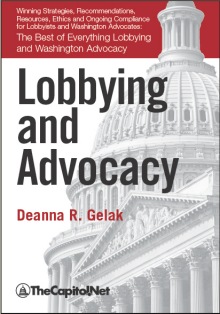
Lobbying and Advocacy
(Hardbound)
Winning Strategies, Resources, Recommendations, Ethics and Ongoing Compliance for Lobbyists and Washington Advocates
The Best of Everything Lobbying and Washington Advocacy

By Deanna Gelak

Lobbying and Advocacy is the comprehensive guide for lobbyists and Washington advocates.

Book Preview

Lobbying and Advocacy, by Deanna Gelak

See larger image


2008, 516 pages

Hardbound, $57
ISBN 10: 1587331047
ISBN 13: 978-1-58733-104-6
LCCN: 2008906619
Dimensions: 7 x 10 x 1.14
Weight: 2.7 pounds 


Available from your bookseller or online

Reviews
Table of Contents
The Author
Related Resources
Details
Buy hardbound from TheCapitol.Net
Buy this publication

Buy hardbound from Amazon
Buy this publication from Amazon.com
(opens in new window)

Buy hardbound from Barnes & Noble
(opens in new window)
Formats
Hardbound $57
Softcover    $47
Ebook         
Find Lobbying and Advocacy in a library near you.

Bookmark and Share

  • Top strategies for winning as an effective lobbyist or Washington advocate.

  • Practical resources and methods for maintaining compliance and staying abreast of ethical and legal requirements.

  • Practical tips, research-based methods, and step-by-step guides for communicating with policymakers in every venue most effectively, including telephone calls, emails, congressional meetings, testifying before Congress, building coalitions, and working with the press.

  • Extensive list of Lobbying and Advocacy Resources on the web


  Reviews


"Deanna Gelak tells it all, in a comprehensive, straightforward, and easy-to-use book on the art and science of lobbying in the US Capitol. Deanna herself is one of the most highly respected lobbyists in this town: effective, ethical, and enthusiastic.  This work is required for all who make their living 'petition(ing) their government for redress and grievances.'
It is a clear road map to success in Washington, DC."
-- Steve Bartlett, President and CEO, The Financial Services Roundtable
(former Member of Congress (R-TX 1983-1991) and Former Mayor of Dallas, TX (1991-1995))


"Lobbying and Advocacy by Deanna Gelak is a great resource for anyone who works in Washington or who wants to know how public policy advocacy really works. Deanna has seen the 'sausage being made' while both working in the Government and lobbying, and her book combines the history and the how-to's of lobbying in one place. This is required reading for students and experienced lobbyists."

-- Andy Mekelburg, Vice President, Federal Government Relations, Verizon


Lobbying and Advocacy is loaded with practical tips and resources for effective and ethical lobbying on Capitol Hill and in the executive branch. This book is useful whether you are overseeing a government relations function, launching a lobbying effort, building coalitions, or monitoring public policy.  While many books discuss lobbying and advocacy, this book concisely highlights the most effective ways to do so. Lobbying and Advocacy is the ultimate lobbyist's handbook."
-- Randel K. Johnson, Vice President, US Chamber of Commerce (former Congressional committee minority counsel and former executive branch official)


"There are lots of books on lobbying, but, until now, none has provided a comprehensive treatment of what lobbyists do and how they can best do it. Deanna Gelak's Lobbying and Advocacy exhaustively covers the basics of lobbying history, legal framework, congressional processes, and ethics. But the strength of this volume is in its practical advice, checklists, and collection of best practices covering direct advocacy, media relations, grassroots organizing, and coalition building. It is a unique volume and should be on the bookshelf of both beginning lobbyists and senior government relations executives. College and law school professors also now, for the first time, have a single textbook for lobbying courses."
-- Thomas M. Susman, Director, Governmental Affairs Office, American Bar Association


"In Lobbying and Advocacy, Deanna Gelak has combined her lobbying experience and extensive research with a vision of open, ethical, and transparent advocacy.  The result is a resource sure to empower both lobbyists and citizen activists.  This powerful guidebook offers step-by-step instruction for influencing policy, tracking legislation, and holding representatives accountable.  Lobbying and Advocacy provides both practical guidance and social and historical context, and is a unique illumination of the mechanisms of power in Washington."
-- John Wonderlich, Sunlight Foundation


"Lobbying and Advocacy by Deanna Gelak is a great primer and a thorough resource, full of good, practical advice.  It should be in every association's library."
-- Paul W. Hallman, President, MultiState Associates, Inc.

"Lobbying and Advocacy by Deanna Gelak is a comprehensive resource manual on legislative issue advocacy. It is a one-stop resource for both beginners and longtime lobbyists. The coverage is thorough. For example, not only does the book debunk the myth that the term "lobbyist" was coined in the lobby of the Willard Hotel in Washington, DC, it provides examples of specific lobbying efforts and makes them into relevant teaching opportunities. The book also includes pertinent editorial cartoons, primary source data, and relevant historical quotes, hundreds of relevant sources and web addresses for lobbying research on issues, legislators, congressional rules, ethics regulations, potential lobbying vendors and lobbying reporting requirements, making this an incredible lobbying resource. From the U.S. Constitutional background of lobbying to a discussion of the current federal lobbying disclosure regulations, Gelak's book has it all.  Every lobbying team will hope their legislative opponents don't have this very effective resource. If you want to gain an advantage for your lobbying team, this book is the one-stop resource necessary to win your advocacy effort."
-- Ned Monroe, Vice President of Political Affairs, National Restaurant Association


"This book is a gold mine for the new or veteran lobbyist. There is a wealth of tips and strategies on issue research, media, building coalitions and effective lobbying communications. I wish I had this book years ago when I started out as it would have saved me a lot of work and prevented many mistakes."
-- David G. Evans, State Lobbyist (NJ) and Author: Federal and State Guide to Employee Medical Leave, Benefits, and Disabilities Laws; and Drug Testing Law, Technology and Practice


"Lobbying is as American as apple pie. Benjamin Franklin lobbied in London for Pennsylvania and other colonies, and the Constitution recognizes our right 'to petition the government for a redress of grievances.' Deanna Gelak provides in Lobbying and Advocacy an invaluable guide for all citizens interested in exercising this constitutional right."
-- Michael Barone, Senior Writer, U.S. News & World Report; Resident Fellow, American Enterprise Institute; Co-author, The Almanac of American Politics


"Lobbying and Advocacy offers an in depth look at the various influences on the government and is a valuable resource for those inside the federal government seeking to understand these influences."
-- Captain Russ Shaffer (Ret.), Former Director, Congressional Affairs, U.S. Navy

 
  Table of Contents


Preview
(Table of Contents below)
Lobbying and Advocacy, by Deanna Gelak, Preview


Summary of Contents

About the Author
Preface
Section I: The True Nature of Lobbying
Chapter 1: The True Nature of Lobbying
Section II: The Top Strategies for Winning on Capitol Hill
Chapter 2: Legal and Ethical Considerations
Chapter 3: Position Drivers: Forces That Shape Legislation
Chapter 4: Understanding Government Institutions and Processes
Chapter 5: Know Your Issue (Well Enough for the Toughest Questions)
Chapter 6: Build the Right Plan
Chapter 7: Develop, Never Devalue, Grassroots
Section III: Presenting Your Message
Chapter 8: Communicate Effectively with Policymakers: Personal Meetings, Letters, Phone Calls, and Electronic Communications
Chapter 9: Multiply Your Influence: Coalitions and Partners
Chapter 10: Media Engagement and Testimony: Perfect Your Public Presence
Chapter 11: Managing and Maintaining a High-Performance Government Affairs Program
Section IV: Epilogue: Keeping It All in Perspective
Appendices
Index


Table of Contents

About the Author
Preface

Section I:  The True Nature of Lobbying

Chapter 1:  The True Nature of Lobbying
1.1  Introduction
1.2  The Textbook Definition of Lobbying
1.3  The Constitutional Basis for Lobbying
1.4  What Are Special Interests?
1.5  A Brief History: The Origin and Development of the Term "Lobbyist"
1.6  What's in a Name?
1.7  The Profession's Forefathers
1.8  Lobby Facts: Historical Quotes
1.9  Recommended Resources: Historical Documents
1.10  Federal, State, and Local Lobbying
1.11  Two Major Parts of Lobbying Work
1.12  Benefits of Lobbying
1.13  How Do Lobbyists Divide Their Work Time?
1.14  Stereotypes
1.15  Three Major Types of Lobbyists
1.16  Number of Registered Lobbyists per Subject Area
1.17  Work Experience
1.18  Education
1.19  Gender Breakdown of Federal Registered Lobbyists
1.20  Lobbyists' Compensation
1.21  Personal Qualities Helpful for Lobbying
1.22  How Many Federal Lobbyists Are There?
1.23  How Many State Lobbyists Are There?
1.24  How Many Foreign Agents Are There?
1.25  Types of Registered Lobbyists and Agents (2007)
1.26  Lobby Facts: Number of Lobbyists per Legislator and per Citizen
1.27  Recommended Resources: Databases, Directories, and Reports
1.28  Keep Current: Congressional Databases
1.99  Chapter Summary

Section II: The Top Strategies for Winning on Capitol Hill

Chapter 2:  Legal and Ethical Considerations
2.1  Introduction
2.2  The Ethics Imperative
2.3  Recommended Resources: Determining Compliance with Key Lobbying and Ethics Requirements
2.4  Designing an Effective Compliance System
2.5  Seven Elements of an Effective Government Affairs Compliance System
2.6  Recognize the Constancy of Change
2.7  Lobby Tips: Maintaining Ongoing Compliance
2.8  Overview: Registering as a Lobbyist
2.9  Who Must Register as a Federal Lobbyist?
2.10  What Must Be Reported?
2.11  How to Report to the House
2.12  How to Report to the Senate
2.13  Maintain Confirmation of Your Filings
2.14  Report One: Initial Registration (LD-1 Form)
2.15  Report Two: Periodic Reports (LD-2)
2.16  Report Three: Amendment
2.17  Report Four: New Client Registration
2.18  Report Five: Termination
2.19  Report Six: Gift Rule Attestation and Campaign Contributions
2.20  Recommended Resources: LDA Compliance
2.21  Who Must Register as a State Lobbyist?
2.22  Recommended Resources: State Lobbying and Ethics Compliance
2.23  Who Must Register as a Local Lobbyist?
2.24  Recommended Resources: Local Government Compliance and Ethics
2.25  The Financial Pressures of Political Campaigns
2.26  The Campaign Compliance Imperative
2.27  Common Campaign Pitfalls to Avoid
2.28  Political Campaign Participation and Contribution Dos and Don'ts
2.29  Recommended Resources: Campaign Compliance
2.30  Executive Branch Lobbying Rules
2.31  Highlights of Major Executive Branch Ethics Rules and Restrictions Applicable to Lobbying
2.32  Recommended Resources: Executive Branch Rules
2.33  Keep Current: Executive Branch Rules
2.34  Historical Observations on the Importance of Ethics for Members of Congress
2.35  Congressional Ethics Rules at a Glance
2.36  Congressional Oath of Office
2.37  Filing Complaints Regarding Public Officials
2.38  Recommended Resources: Congressional Ethics Rules
2.39  Keep Current: Congressional Rules
2.99  Chapter Summary

Chapter 3:  Position Drivers: Forces That Shape Legislation
3.1  Introduction
3.2  Study the Legislative District's Demographics and Politics prior to Communicating with the Policymaker
3.3  The Benefits of Studying "Position Drivers"
3.4  Identifying "Position Drivers"
3.5  The Seven "Position Drivers" ("The Seven Ps")
3.6  The Seven Ps—Profile (Constituency Represented)
3.7  The Seven Ps—Previous Experience
3.8  The Seven Ps—Positions
3.9  The Seven Ps—Press and Public Opinion
3.10  The Seven Ps—Promoters
3.11  The Seven Ps—Priorities
3.12  The Seven Ps—Personal Experience
3.13  Understanding and Monitoring the Broader Political Landscape and Environment
3.14  How to Conduct Legislative Forecasting
3.15  Worksheet: Evaluating the Political Environment
3.16  The Significance of Congressional and Party Leadership
3.17  Lobby Tips: How to Determine and Track Congressional Leadership Priorities
3.18  Beyond Party Numbers and Partisan Discipline
3.19  Consider Committees
3.20  Recommended Resources: Tracking Committees
3.21  Consider Caucuses and Specialized Groups (Congressional Member Organizations)
3.22  Recommended Resources: Tracking Congressional Organizations
3.23  Lobby Tips: Utilize the Trade Press in Environmental Assessment and Trend Tracking
3.24  Lobby Fact: Volumes of State Legislation
3.25  Recommended Resources: Tracking State Legislative Environments
3.26  Assessing the Executive Branch Political Policy-making Environment
3.27  Nature or Nurture?
3.99  Chapter Summary

Chapter 4:  Understanding Government Institutions and Processes
4.1  Introduction
4.2  Importance of Gaining and Maintaining a Working Knowledge of the Governmental Institutions and Processes
4.3 Recommended Resources: Capitol History
4.4 A Brief Timeline: Hallmarks of Our Congress and Capital City's History
4.5 Congress's Design of Balance and Deliberate Delay
4.6 Recommended Resources: Basics on Members of Congress and the Legislative Process
4.7  Legislative Process Flowchart
4.8  Basic House and Senate Differences
4.9  Differences between the House and Senate at a Glance
4.10  The Annual Budget and Appropriations Processes
4.11  Congress's Constitutional Power of the Purse
4.12  The Magnitude of the Federal Budget: An Historical Perspective
4.13  Outstanding Government Promises vs. Assets and Historic Revenues
4.14  Recommended Resources: Budget and Appropriations
4.15  Know the Legislative Language
4.16  Congressional Approval Terminology
4.17  Recommended Resources: Legislative Language
4.18  Bill Introduction
4.19  Critical Role of Committees
4.20  Recommended Resources: Committees
4.21  Floor Action
4.22  House Rules Committee and House Floor Votes
4.23  Senate Floor Votes
4.24  Comparing a House Special Rule and a Senate Time Agreement
4.25  Recommended Resources: Floor Votes
4.26  Amendments and Parliamentary Procedures
4.27  Talking Points for Explaining the Amendment Process
4.28  Recommended Resources: Amendments and Parliamentary Procedures
4.29  What is an Earmark?
4.30  Recommended Resources: Earmarks
4.31  Moving through the Second Chamber
4.32  Moving to Conference
4.33  Presidential Consideration
4.34  Respect Congressional Timing and Schedules
4.35  Congressional Sessions and Recesses
4.36  The Principle of Early Intervention: Life Cycle of Lobbying
4.37  Congressional Offices Overview
4.38  Congressional Office Staffing
4.39  Congressional Office Structures
4.40  Different Roles and Responsibilities of Various Types of Congressional Offices
4.41  Essential Role of Congressional Staff
4.42  Recommended Resources: Congressional Staff
4.43  Lobby Tips: Respect the Role of Staff
4.44  The Pace and Stress of the Legislative Office Environment
4.45  Example of a Senior Staffer's Daily Workload
4.46  Congressional Pay
4.47  Recommended Resources: Congressional Staff Salaries
4.48  Location and Facilities of Congress
4.49  Recommended Resources: Capitol Facilities
4.50  Congressional Support Organizations
4.51  Lobby Tips: GAO Reports
4.52  Lobby Tips: CRS Reports
4.53  General Overview of the Regulatory Process
4.54  Selected Regulatory Agency Laws and Rules
4.55  Recommended Resources: Tracking Executive Branch Actions
4.56  Understand the Major Differences between Federal and State Legislative Processes
4.57  Recommended Resources: State vs. Federal Legislative Processes
4.99  Chapter Summary

Chapter 5:  Know Your Issue (Well Enough for the Toughest Questions)
5.1  Introduction
5.2  Prepare before the Session
5.3  Recommended Resources: Conducting Legislative Research
5.4  Special Considerations for Legislative Research
5.5  General Research Tools for Lobbyists
5.6  Ten Considerations for Lobbyists Conducting Research—1. Double-Check and Verify Everything
5.7  Ten Considerations for Lobbyists Conducting Research—2. Consider Confidentiality
5.8  Ten Considerations for Lobbyists Conducting Research—3. Source Everything and Give Credit Where Credit Is Due
5.9  Ten Considerations for Lobbyists Conducting Research—4. Anticipate Scrutiny and Criticism
5.10  Ten Considerations for Lobbyists Conducting Research—5. Consider Where Your Information May End Up
5.11  Ten Considerations for Lobbyists Conducting Research—6. Be Concise and Relevant: Tailor Your Information to the Policymaker's Interests
5.12  Ten Considerations for Lobbyists Conducting Research—7. Clarify Expectations and Deadlines in Advance
5.13  Ten Considerations for Lobbyists Conducting Research—8. Utilize Training before the Session to EnableEfficient and Effective Research
5.14  Ten Considerations for Lobbyists Conducting Research—9. Consider Your Contacts: The Act of Conducting Research Itself Can Be News
5.15  Ten Considerations for Lobbyists Conducting Research—10. Opposition Research: Know Thy Enemy (and Especially Thy Enemy's Arguments)
5.16  Five Basic Steps of Public Policy Research
5.17  Public Policy Research—Step 1: Survey and Collect Existing Information
5.18  Public Policy Research—Step 2: Identify and Collect Existing Information from Experts
5.19  Public Policy Research—Step 3: Study and Evaluate Existing Sources of Information
5.20  Issue Evaluation Template
5.21  Public Policy Research—Step 4: Develop and Formulate Your Information
5.22  Public Policy Research—Step 5: Update Your Facts, Data, and Arguments
5.23  Frequent Mistakes Lobbyists Make in Providing Information to Policymakers
5.99  Chapter Summary

Chapter 6:  Build the Right Plan
6.1  Introduction
6.2  Basic Government Affairs Planning Strategies
6.3  Turning Planning into Execution
6.4  Ten Steps of Legislative Action Planning
6.5  Legislative Action Planning—Step 1: Obtain Member or Client Input
6.6  Legislative Action Planning—Step 2: Evaluate the Political, Legislative, Regulatory, and Judicial Environments
6.7  Legislative Action Planning—Step 3: Consider Your Organization's History and Capabilities
6.8  Legislative Action Planning—Step 4: Prepare for Planning
6.9  Legislative Action Planning—Step 5: Identify and Prioritize Your Issues
6.10  Legislative Action Planning—Step 6: Develop Legislative and Regulatory Action Plans with Specific Goals for Each Issue
6.11  Legislative Action Planning—Step 7: Emphasize Long-Term Goals
6.12  Legislative Action Planning—Step 8: Establish Short-Term Priorities with Metrics to Measure Achievement
6.13  Legislative Action Planning—Step 9: Regularly Update the Plan
6.14  Legislative Action Planning-Step 10: Communicate Your Successes
6.15  Tips for Executing Your Plan
6.16  Quotes for Overcoming Obstacles
6.99  Chapter Summary

Chapter 7:  Develop, Never Devalue, Grassroots
7.1  Introduction
7.2  Remember Who You Work For
7.3  Checklist for Organizing and Maintaining an Effective Grassroots Network
7.4  Seven Components for Building and Maintaining an Effective Grassroots Network
7.5  Components for Building and Maintaining an Effective Grassroots Network—1: Identify and Recruit
7.6  Worksheet for Identifying Grassroots Recruiting Resources
7.7  Components for Building and Maintaining an Effective Grassroots Network—2: Motivate
7.8  Encouraging Citizen Engagement: Motivational Notes and Quotes
7.9  Components for Building and Maintaining an Effective Grassroots Network—3: Organize
7.10  Components for Building and Maintaining an Effective Grassroots Network—4: Educate
7.11  Components for Building and Maintaining an Effective Grassroots Network—5: Energize
7.12  Case Study: The Power of Personal Involvement
7.13  Components for Building and Maintaining an Effective Grassroots Network—6: Recognize
7.14  Components for Building and Maintaining an Effective Grassroots Network—7: Evaluate
7.15  Checklist for Planning and Executing a Site Visit
7.16  A Practical Example of a Legislative Conference Grassroots Success
7.17  Recommended Resources: How to Get Around on Capitol Hill
7.18  Grassroots Databases
7.19  Grassroots Communications Vendors
7.20  Recommended Resources: TheCapitol.Net Training
7.99  Chapter Summary

Section III:  Presenting Your Message

Chapter 8:  Communicate Effectively with Policymakers: Personal Meetings, Letters, Phone Calls, and Electronic Communications
8.1  Introduction
8.2  Basic Dos and Don'ts That Apply to All Modes of Lobbying Communications
8.3  Making Your Message Stand Out from the Din: Postal and Email Communications to Capitol Hill 1995-2004
8.4  The 30 Laws of Lobbying
8.5  Five Principles for Effective Legislative Communications: The "CHATS" Method for Communicating with Congressional Members and Staff
8.6  Determining the Best Mode of Communication
8.7  Respect Individual Communication Preferences
8.8  Getting Connected Quickly and Breaking the Barrier
8.9  Recommended Resources: Making and Keeping the Right Connections
8.10  The Typical Order of Congressional Communications
8.11  An Example of Simultaneous and Integrated Washington Lobbyist and Grassroots Activities
8.12  Lobby Tips: Early Identification and Contact of the Key Influentials
8.13  Continually Cultivate Contacts
8.14  Identify Legislative Leaders and Potential Champions
8.15  Lobby Tips: Cultivating Legislative Champions
8.16  Develop a Target List
8.17  Identify Key Committee and Personal Office Staff
8.18  Making a Target List for Ranking Legislators' Positions
8.19  Tips for Personalized Letters
8.20  Personalized Letters vs. Form Letters
8.21  Lobby Tips: Assisting Constituents Writing Letters
8.22  Congressional Letter Formatting
8.23  Lobby Tips: Expedited Delivery of Letters to Congress
8.24  Effective Phone Calls
8.25  Lobby Tips: Call-in Days
8.26  The Importance of Effective Congressional Meetings
8.27  Constituent Meetings Compared to Other Congressional Communications
8.28  Ten Tips for Effective Meetings
8.29  Reminders for Hill Visit Participants
8.30  Sample One-Pager
8.31  Legislative Conference/Hill Day Checklist for Event Organizers
8.32  Coaching Grassroots: Practice for Personal Meetings
8.33  How to Construct a Role Play Exercise: Preparing to Meet with a Member of Congress
8.34  Components: How Not to Meet with a Member of Congress Exercise
8.35  Components: How to Meet with a Member of Congress Exercise
8.36  Example Script: Role Play Exercise
8.37  Tips for Sending Email
8.38  Sample Email to Congressional Staff
8.39  The Limitations of Email-Only Grassroots Campaigns
8.40  Follow-up and Continue to Build a Relationship
8.41  Special Considerations for State and Multi-State Lobbying
8.42  The 25 Fundamentals for Successful State Lobbying
8.43  Recommended Resources: Effective State and Local Lobbying
8.44  Special Considerations for Executive Branch Lobbying
8.45  Executive Branch Lobbying—Do Your Homework: Understand Existing Administration Policies
8.46  Executive Branch Lobbying—Respect Executive Branch Ethics and Disclosure Requirements
8.47  Executive Branch Lobbying—Understand the Environment and Position Determinants
8.48  Executive Branch Lobbying—Know the Process and Work It
8.49  Executive Branch Lobbying—Respect Agency Staff
8.50  Tips for Providing Official Comments on Proposed Federal Regulations
8.51  How to Contact the White House and Agency Officials
8.52  Preparing for Executive Branch Meetings
8.53  Recommended Resources: Effective Executive Branch Lobbying
8.54  Number and Turnover Rate of Political Appointees in Cabinet-Level Agencies
8.55  Advocacy and the Judicial Process
8.56  Lobby Tips: U.S. Supreme Court
8.99  Chapter Summary

Chapter 9:  Multiply Your Influence: Coalitions and Partners
9.1  Introduction
9.2  Benefits of a Coalition Effort
9.3  A Profile of Coalition Utilization
9.4  Coalition Involvement Survey
9.5  Disclosure of Lobbying Activities
9.6  Challenges Confronting Legislative Coalitions
9.7  Frequent Coalition Challenges and Solutions
9.8  Expanding Your Efforts
9.9  Effectively Addressing Conflict
9.10  Example of a Typical Coalition Meeting Agenda
9.11  Motivating Quotes for Coalition Teamwork
9.12  Coalition Organization: Examples of Varying Degrees of Structure
9.13  A Tool to Empower Allies to Maintain Effective Coalitions
9.14  Time Management
9.15  Developing Your Members and Allies
9.99  Chapter Summary

Chapter 10:  Media Engagement and Testimony: Perfect Your Public Presence
10.1  Introduction
10.2  Legislative Messaging in a Crowded Environment
Section I: Media Engagement
10.3  "How-to Guide" for Working with the Media
10.4  Media Relations Principle 1: Understand the Ultimate Goal
10.5  Media Relations Principle 2: Plan and Coordinate
10.6  Media Relations Principle 3: Conduct an Audit Issue
10.7  Recommended Resources: Conducting a Press Audit on an Issue or Organization
10.8  Media Relations Principle 4: Select a Credible Spokesperson
10.9  Considerations for Selecting Spokespersons
10.10  Lobby Tips: Preparing Spokespersons for Public Appearances
10.11  Tips for Preparing for Your Physical Presence on Television
10.12  Media Relations Principle 5: Know Your Issue and Anticipate Questions
10.13  Lobby Tips: Legal and Substantive Details
10.14  Media Relations Principle 6: Hone Your Message
10.15  Media Relations Principle 7: Consider and Coordinate Various Media
10.16  Recommended Resources: Video Archives of House and Senate Proceedings
10.17  The Influence Model of Communications
10.18  Earned vs. Paid Media
10.19  Media Relations Principle 8: Get the Word Out Strategically and Target State/District Outlets
10.20  Press Distribution Resources for Lobbyists
10.21  Media Relations Principle 9: Timing Is Everything
10.22  Media Relations Principle 10: Follow-up
10.23  Working with Reporters
10.24  Lobby Tips: On the Record
10.25  Lobby Tips: Practice and Mock Interviews
10.26  Press Checklists
10.27  Recommended Resources: Journalism Ethics
10.28  Considerations for Consultants
Section II: Legislative Events
10.50  Tips for Coordinating Legislative Events
10.51  Addressing Elected Officials and Their Spouses: Pronunciations and Protocol
10.52  Lobby Tips: Introducing a Member of Congress
10.53  Arrival Checklist
10.54  What to Bring Checklist
10.55  Recommended Resources: Legislative Speeches
10.56  Tips for Legislative Update Presentations
10.57  Effective Congressional Testimony Strategies
10.58  General Tips on Testifying before Congress
10.59  Expectations for Witnesses Testifying before Congress
10.60  Your Rights when Testifying before Congress
10.61  Step-by-Step Checklist for Testifying before Congress or Preparing a Witness
10.62  Lobby Tips: Preparing Written Congressional Testimony
10.63  Recommended Resources: Drafting Testimony
10.64  Template for Written Congressional Testimony
10.65  Preparing for Questions
10.66  Common Witness Errors when Testifying before Congress
10.67  Submitting Testimony for the Record
10.68  Sample Table of Contents: Briefing Book for a Congressional Witness
10.69  Tips for Attending Congressional Hearings
10.70  Diagram of a Typical Congressional Hearing Room
10.99  Chapter Summary

Chapter 11:  Managing and Maintaining a High-Performance Government Affairs Program
11.1  Introduction
11.2  Hire Qualified, Ethical, and Effective Staff
11.3  Look for Legislative Experience
11.4  Recruit and Tap Talent
11.5  Recommended Resources: Finding Lobbyist Candidates
11.6  Recommended Resources: Reference Checking
11.7  Compensate Competitively
11.8  Recommended Resources: Determining Lobbyists' Salaries
11.9  Recommended Resources: Resources for Lobbyists Seeking Employment
11.10  Take Time for Training and Developing Staff
11.11  Recommended Resources: Training and Development
11.12  Get Your Staff on Board with Your Mission
11.13  Organize Your Team Effectively
11.14  Corporate Government Affairs Organization
11.15  Encourage Time Management and Avoid Burnout
11.16  Lobby Tips: Avoiding Burnout
11.17  Quotes on Time Well-Kept
11.18  Time Management Tips
11.19  Analyze Staff Activities
11.20  Worksheet: Function Resources
11.21  Measure What Matters
11.22  Budget for Maximum Results
11.23  Effectively Leverage and Update Technology
11.24  Contract Cautiously
11.25  Lobby Tips: Put It in Writing
11.26  Keep a Record
11.27  Recordkeeping Time Lines Checklist, and Confidentiality
11.28  Assessing Risk Exposure
11.99  Chapter Summary

Section IV:  Epilogue: Keeping It All in Perspective

Appendices
Appendix 1:  Lobbying and Government Relations: Checklist of Basic Lobbying Techniques and Strategies
Appendix 2: How to Monitor and Influence Policy at the Federal Level
Appendix 3.  A Practical Guide To Working The Hill And Guiding Congressional Witnesses / Hill Visitors, including Capitol Hill Map with parking indicated (16-page PDF ) (see also Capitol Hill: Map, Parking, Buildings, Hotels, Restaurants)
Appendix 4:  A Select Glossary of Lobbying Terms, Abbreviations, and Acronyms
Appendix 5:  The Lobbyist's Annual Calendar: Key Dayes and Activities Template With Annual Schedule Highlights
Appendix 6:  Lobbyists' Code of Ethics
Appendix 7:  Amendments to the Lobbying Disclosure Act, the Foreign Agents Registration Act, and the Federal Election Campaign Act, by Showing Changes to Previous Law Made by The Honest Leadership and Open Government Act of 2007 [HLOGA]

Index
 

  The Author


Deanna GelakDEANNA GELAK has worked in the legislative branch, executive branch, and private/nonprofit sector arenas since 1984. She is Founder and President of Working for the Future, LLC, a public policy firm that advises organizational spokespersons and citizen leaders on effective political involvement and communication strategies.


Ms. Gelak served two terms as the President of the American League of Lobbyists, the national professional association for lobbyists. In that capacity, she served as chair of the board and the national spokesperson for the advocacy profession.


She has promoted the importance of effective and ethical lobbying in such venues as C–SPAN's Washington Journal, National Public Radio's Talk of the Nation, and the National Press Club. Her press interviews have also included: NBC Nightly News, MSNBC, Associated Press, Scarborough Country, Fox News, several National Public Radio shows, The Tavis Smiley Show, America's Voice, Wall Street Journal, Time Magazine, Wall Street Journal Talk, The Mary Matalin Show, National Press Club, Monitor Radio, Bloomberg, Family News in Focus, National Journal, United Press International, Washington Post, Washington Times, Roll Call, USA Today, Investors Business Daily, CBS Marketwatch.com, Chicago Tribune, San Francisco Chronicle, Knight Ridder/Tribune, Strategic Finance, Christian Science Monitor, Boston Globe, Boston Herald, Baltimore Sun, Austin Statesman, Orlando Sentinel, Miami Herald, Business Insurance, Business Week, Parenting, Parents, Glamour, and Working Woman.


She is a faculty member for TheCapitol.Net, and a certificate trainer for the American League of Lobbyists' Lobbying Certificate Program (LCP).


Ms. Gelak assists leaders to more effectively influence public policy. Her communications' training method has been used in Afghanistan, Jordan, Morocco, and Iraq. She designed the "mock Congress" for National 4–H to educate high school students from across the nation on how Congress works.


Ms. Gelak has led numerous Congressional coalitions. For example, she chaired the national Congressional Coverage Coalition, the successful effort to make labor and civil rights laws applicable to members of Congress and their staffs for the first time in history. Previously, members of Congress were exempt from the labor and civil rights laws that they had passed for the rest of the country.


Ms. Gelak achieved certification as a Senior Professional in Human Resources (SPHR), which reflects her expertise in human resource policy issues. She is the former director of governmental affairs for the Society for Human Resource Management, a professional society with more than 175,000 professional members and has authored numerous articles and publications on various workplace public policy issues. She has achieved significant expertise on work-life balance policy issues and served on a Bureau of National Affairs advisory committee in that area. Ms. Gelak also has worked for the Committee on Education and Labor of the U.S. House of Representatives and as a Congressional liaison officer in the executive branch (U.S. Department of Labor).


Originally from Niceville, Florida, Ms. Gelak is a graduate of the University of Florida. 

 

  Related Resources

Lobbying and Advocacy mug
Lobbying and Advocacy mug by TheCapitolNet

Live Courses

How to Organize a Capitol Hill Day, Audio Course on CD

Capitol Learning Audio Courses Audio CD  and Print Materials
   
Capitol Learning Audio Courses Online download with MP3 audio and materials in PDF
Capitol Learning Audio Courses

Capitol Learning Audio Courses are a convenient way to learn about the legislative process, federal budgeting, media relations, business etiquette, and much more.  Each course is between 1/2 hour and 2 hours long, and includes the course materials. 

Our Capitol Learning Audio Courses can be customized with your logo in quantities of 250 to 10,000 copies.  Contact our Client Liaison for details.

We recommend
 

Lobbying and Advocacy Sourcebook
The companion volume to Lobbying and Advocacy


"The Lobbying Manual: A Complete Guide to Federal Lobbying Law and Practice, Fourth Edition"
By William V. Luneburg, Thomas M. Susman, and Rebecca H. Gordon
From the American Bar Association

Lobbyist Registration and Compliance Handbook

Lobbyist Registration and Compliance Handbook

Also see


Persuading Congress

Lobbying, PACs, Campaign Finance: 50 State Handbook
United States Government Manual
The Lobbying Manual: A Complete Guide to Federal Law Governing Lawyers and Lobbyists

The Almanac of American Politics

Politics in America 2010
State Rankings 2010

Washington Information Directory (WID)

The Almanac of the Unelected 2009

CQ Federal Staff Directory (subscription)

Lobbying and Policy Change: Who Wins, Who Loses, and Why

National Trade and Professional Associations of the United States


  Details

Lobbying and Advocacy:  Winning Strategies, Resources, Recommendations, Ethics and Ongoing Compliance for Lobbyists and Washington Advocates
By Deanna Gelak 

Lobbying and Advocacy
By Deanna Gelak

Softcover
$47

Buy this publication
 
Softcover: 516 pages 
ISBN 10: 1587331004
ISBN 13: 978-1-58733-100-8
LCCN: 2008906619
Published 2008
Dimensions: 7 x 10 x 1.04
Weight: 2 pounds  
 
Hardbound
$57

Buy this publication
 
Hardbound: 516 pages 
ISBN 10: 1587331047
ISBN 13: 978-1-58733-104-6
LCCN: 2008906619
Published 2008
Dimensions: 7 x 10 x 1.12
Weight: 2.7 pounds
   
Lobbying and Advocacy Sourcebook
Softcover
$35

Buy this publication
 
Softcover: 416 pages 
ISBN 10: 1587331055
ISBN 13: 978-1-58733-105-3
LCCN: 2008906618
Published 2008
Dimensions: 7 x 10 x 0.9
Weight: 1.6 pounds 


Bookmark and Share


TheCapitol.Net is a non-partisan firm, and the opinions of its faculty, authors, clients and the owners and operators of its vendors are their own and do not represent those of TheCapitol.Net. 


  URLs: TheCapitol.Net/Publications/lobbyingandadvocacy.html
LobbyingandAdvocacy.com
EffectiveLobbying.com
EffectiveLobbyist.com
EffectiveLobbyists.com
LobbyingHandbook.com
LobbyistHandbook.com
LobbyingDeskbook.com
LobbyistDeskbook.com
LobbyingEffectively.com
AdvocacyandLobbying.com
LobbyingAdvocacy.com
AdvocacyLobbying.com

 
Last updated: September 02, 2010

  FAQs Client Care Visiting
Washington, DC
General Links  
  Public Courses
Payment, Cancellation, Substitution & Transfer
Custom On-Site Training
Publications
Capitol Learning Audio Courses TM
- Limited License
Congress and Washington, DC

Policies
Pre-filled Form W-9 (1-page PDF)
Registration Information
Payment, Cancellation, Substitution, and Transfer Policy
Capitol Hill Hotels and Restaurants
Maps and Directions
Weather/Snow Policy
What to Wear
Where to Stay
Return Policy
Suggestion Forms
General Information About DC
How to Get Into, Around And Out Of Washington, DC
Maps and Directions
Books and Maps for Visitors
Books for Children
Museums, Memorials & Monuments
Song, Dance & Theater
Sports
Beltway Map

DC Weather
About Us
- News
Legislative Glossary
You Have Two Cows
Privacy Notice
Clients
Faculty and Authors
Links
Research Links
Email Update
Contact Us
Search


TheCapitol.Net, Inc.

PO Box 25706, Alexandria, VA  22313-5706
Phone: 703-739-3790   Fax: 703-739-1195    Email Us

Copyright © 1999-2010 by TheCapitol.Net, Inc.  All Rights Reserved.