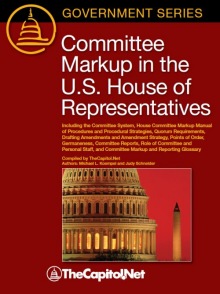
Committee Markup in the U.S. House of Representatives (Softcover and ebook)
Including The Committee System, House Committee Markup Manual of Procedures and Procedural Strategies, Quorum Requirements, Drafting Amendments and Amendment Strategy, Points of Order, Germaneness, Committee Reports, Role of Committee and Personal Staff, and Committee Markup and Reporting Glossary
Compiled by TheCapitol.Net
Detailed description of how congressional committees and
subcommittees debate, amend, and rewrite proposed legislation,
including the
House Committee Markups Manual of Procedures and Procedural
Strategies.
1. "Committee Markup, Section 8.50-8.53 from
"Congressional Deskbook," by Michael L. Koempel and Judy
Schneider"Committee Markup," from
Congressional Deskbook, by Michael Koempel and Judy
Schneider . . . . . . . . . . . 1
Sec. 8.50 Committee Markup
Sec. 8.51 Committee Markup and Reporting Glossary
Sec. 8.52 Keeping Up with House and Senate Committee
Markups
2. "The Committee System in the U.S. Congress," CRS
Report for Congress RS20794, March 21, 2007
. . . . . . . . . . . . . . . 9
- Introduction
- Structure and Organization
- Types of Committees
- Subcommittees
- Composition
- Leadership
- Staff
- Oversight
- Operations and Procedures
- Referral
- Executive Agency Comment
- Hearings
- Markup
- Report
- Committees and Chamber Action
- Related CRS Reports
3. "House Committee Markups: Manual of Procedures and
Procedural Strategies," CRS Report for Congress R41083,
February 25, 2010
. . . . . . . . 19
1. Overview of Manual
2. Introduction to House Committee Markup Procedures
2.1. What Rules Apply in Committees?
2.2. Summary of Procedures of the House as in the
Committee of the Whole as They Operate in House
Committees
2.3. Importance of Procedure in Committee
3. Committee Rules
3.1. Subcommittees
3.2. Meetings
3.2.1. Meeting Days and Chairing Meetings
3.2.2. Members' Initiative to Hold a Markup
3.2.3. Notice and Documents
3.2.4. Open and Closed Meetings
3.2.5. Media Coverage
3.3. Opening Statements
3.4. Postpone Votes
3.5. Quorum Requirements
3.6. Recess
3.7. Reporting
3.8. Subpoenas
3.9. Committee Records
4. Procedural Restrictions in Law on Certain Markups
5. Referral of Legislation in the House
5.1. House Rules on Referral
5.2. Speaker's Authority
5.3. Drafting Strategy and the Referral of Legislation
5.4. Protecting a Committee's Jurisdiction
6. Considerations Prior to a Markup
6.1. Timing
6.2. Party Leadership Planning
6.3. Public and Media Attention
6.4. Should Subcommittee Markup Precede Committee
Markup?
6.5. Legislative Vehicle
6.6. Chair Responsibilities: Markup And Floor
6.6.1. Scheduling Meetings and Setting an Agenda
6.6.1.1. Pre-Meeting Party Caucuses
6.6.2. Maintaining Order and Decorum
6.6.2.1. Parliamentary Inquiries
6.6.2.2. Points of Order, Dilatory Motions, and Appeals
6.6.3. Reporting Legislation
6.6.4. Floor Consideration
7. Procedural Strategy and the Choice of a Markup
Vehicle
7.1. Introduced Measure
7.2. Subcommittee Version--Committee Print
7.2.1. Options for Action on Committee Print
7.2.2. Committee Print as Markup Vehicle
7.2.3. Committee Print as Amendment in the Nature of a
Substitute
7.3 Staff Draft--Chairman's Mark
7.3.1. Original Measure
7.3.2. Managers' Amendment
7.4. Amendment in the Nature of a Substitute
7.5. Markup Based on Sole, Primary, Additional Initial,
or Sequential Referral
8. Beginning a Markup
8.1. Notice
8.1.1. Unfinished Markup
8.2. Quorum and Call to Order
8.3. Opening Statements
8.4. Calling Up and Reading the Measure
8.5. Potential Motions as a Measure Is Called Up
8.5.1. Question of Consideration
8.5.2. Motion to Postpone
8.6. Unanimous Consent
8.6.1. Unanimous Consent Implied
9. Reading a Measure for Amendment
9.1. General Debate
9.2. Options for Reading for Amendment
9.2.1. Reporting, Reading, or Designating a Section or
Other Unit
9.2.2. Reading for Amendment by Section
9.2.3. Reading for Amendment by Title or Another Unit
9.2.4. Open to Amendment at Any Point
9.2.5. Amendment Roster
9.3. Reading an Amendment
9.4. Drafting Amendments and Amendment Strategy
9.5. Form, Scope, and Degree of Amendments
9.5.1. Form
9.5.2. Scope
9.5.3. Degree
9.6. Relationship among Amendments
9.6.1. Order of Offering Amendments Based on Their Scope
9.6.2. The Amendment Tree
9.6.3. Who May Offer an Amendment
9.6.4. Precedence of Amendments When Their Form Is To
Strike, or To Strike and Insert, an Entire Section of
Base Text
9.6.4.1. Motion to Strike an Entire Section
9.6.4.2. Motion to Strike Out an Entire Section and
Insert New Text
9.6.4.3. Motion to Amend a Portion of a Section
9.6.5. Order of Voting on Amendments
9.7. Amendment in the Nature of a Substitute
9.7.1. Offering
9.7.2. Reading
9.7.3. Amending
9.7.3.1. Amending Text Not Made Base Text
9.7.3.2. Amending Text Made Base Text
9.7.4. Adopting
9.8. Additional Procedural Considerations for Amendments
9.8.1. Precedence of the Motion to Amend
9.8.2. In Writing
9.8.3. Amending Amended Text
9.8.4. Reoffering an Amendment
9.8.5. En Bloc Amendments
9.8.6. Modifying an Amendment
9.8.7. Withdrawing an Amendment
9.8.8. Amendment to the Title
9.8.9. Motion to Strike the Enacting Clause
9.9. Debate on Amendments
9.9.1. Five-Minute Rule
9.9.2. Decorum
9.9.2.1. Chair's Duty
9.9.2.2. Members' Responsibilities
9.9.2.3. Disorderly Language or Words Taken Down
9.9.3. Limiting or Closing Debate
10. Parliamentary Inquiries
11. Points of Order
11.1. Making or Reserving a Point of Order against an
Amendment
11.1.1. Making a Point of Order
11.1.2. Reserving a Point of Order
11.2. Demand for Regular Order
11.3. Debate and Chair's Ruling
11.4. Appeal of the Chair's Ruling
11.5. Germaneness
11.5.1. Text to Which an Amendment Must Be Germane
11.5.2. Tests, Principles, and Applications of the
Germaneness Rule
11.5.3. Sources of Information on Tests, Principles, and
Applications
11.5.4. Subject-Matter Test
11.5.5. Fundamental Purpose Test
11.5.6. Committee Jurisdiction Test
11.5.7. Individual Proposition or Class Not Germane to
Another
11.5.8. General Provision Not Germane to a Specific
Subject
11.5.9. Specific Subjects Germane to General
Propositions
11.5.10. Studies
11.5.11. Amendments Imposing Conditions, Qualifications,
or Limitations
11.5.12. Amendments to Bills Amending Existing Law
11.6. Rule X Committee Jurisdiction Point of Order
11.7. Constitutionality Point of Order
11.8. Matters Not Subject to a Point of Order
12. Motions
12.1. To Adjourn
12.2. To Commit or Recommit to a Subcommittee
12.3. To Discharge a Subcommittee
12.4. Previous Question
12.5. To Recess
12.6. To Table
13. Voting
13.1. Forms of Voting
13.2. Majority Vote
13.3. Motion to Reconsider
13.4. Order of Voting on Amendments
13.5. Divisibility of a Question
13.6. Postponing Votes
14. Reporting a Measure
14.1. Options for How a Committee May Report to the
House
14.1.1. Report Favorably
14.1.2. Report Unfavorably
14.1.3. Report without Recommendation
14.2. Options for Reporting Recommended Changes to the
House
14.2.1. Without Amendment
14.2.2. Cut and Bite Amendments
14.2.3. Clean Bill or Resolution
14.2.4. With an Amendment in the Nature of a Substitute
14.3. Subcommittee Reporting
14.4. Actions by a Committee in the Course of Reporting
14.4.1. Motions to Approve and Report
14.4.2. Motion to Reconsider
14.4.3. Minority and Other Views
14.4.4. Technical and Conforming Changes
14.4.5. Authorization to Seek Conference with Senate
14.4.6. Script to Approve and Report a Measure with an
Amendment in the Nature of a Substitute, Not Base Text
14.4.7. Script to Approve and Report a Measure with an
Amendment in the Nature of a Substitute, Made Base Text
14.5. Sponsorship and Cosponsorship of Reported Measures
15. Committee Reports
15.1. Preparing and Filing a Committee Report
15.1.1. Privileged and Nonprivileged Reports
15.2. Late Filing of a Committee Report
15.3. Required Contents of a House Committee Report
15.4. Report with Parts--Measures Referred to More Than
One Committee
15.5. Supplemental Report
15.6. Star Print
15.7. Consequences of Rules Violations in Markups and
Committee Reports
15.7.1. Committee Reports and Reporting
15.7.2. Remedy
16. Options for House Floor Consideration
16.1. Routes to the Floor
16.1.1. Legislation That Is Considered in the House
16.1.2. Suspension of the Rules
16.1.3. Special Rules
16.1.4. Other Routes
16.2. Considerations Pertinent to a Special Rule
16.2.1. Floor Vehicle
16.2.2. Waivers of Points of Order
16.2.3. General Debate
16.2.4. Amendments Made in Order
16.2.5. Motions Precluded or Restricted
16.2.6. House Action
16.2.7. Motion to Recommit
16.2.8. Post-Passage
17. Considerations in a Two-House Strategy
18. Role of Committee and Personal Staff
18.1. Administrative Preparation
18.2. Procedural Preparation
18.3. Issue Preparation
Figures
Figure 1. Sample Committee Markup Notice
Figure 2. Sample Committee Amendment Form
Figure 3. House Amendment Tree
Tables
Table 1. Motions, Demands, and Requests Commonly Made in
Committee Markups
Table 2. Required Contents of House Committee Reports
Appendixes
Appendix A. Glossary of Selected Markup Terms
Appendix B. House Committee Markup: Administrative
Preparation
Appendix C. Sample Script for Opening Statements
Appendix D. Sample Scripts for Calling Up and Reading a
Measure
Appendix E. Sample Scripts When Motions Are Made as a
Markup Begins
Appendix F. Sample Scripts for Options for Reading a
Measure for Amendment
Appendix G. Sample Script for Offering an Amendment in
the Nature of a Substitute
Appendix H. Sample Scripts for Offering an Amendment and
Disposing of a Point of Order
Appendix I. Sample Scripts for Selected Motions and
Requests in the Amendment Process
Appendix J. Sample Scripts for Motion to Close Debate;
Parliamentary Inquiry; and Point of Order of Absence of
Quorum
Appendix K. Sample Scripts for Voting on Amendments
Appendix L. Sample Script for Parliamentary Inquiry on
Voting Order on Amendments, with Votes on Amendments to
an Amendment in the Nature of a Substitute Made Base
Text
Appendix M. Sample Scripts for Division of a Question:
Amendments and En Bloc Amendments
Appendix N. Sample Scripts for Postponing a Recorded
Vote; Calling a Recess
Appendix O. Sample Script for Subcommittee Reporting
Appendix P. Sample Script for Reporting a Measure with
or without Amendments, or with an Amendment in the
Nature of a Substitute Considered as Base Text
Appendix Q. Sample Script for Reporting a Measure with
an Amendment in the Nature of a Substitute, Not Base
Text
Appendix R. Sample Script for Reporting a Clean Bill or
Resolution
Appendix S. Consideration and Reporting of a Measure by
Unanimous Consent
4."House Committee Markup: Vehicle for
Consideration and Amendment," CRS Report for Congress
98-188, July 17, 2008 . . . . . . . 235
- Introduced Measure
- Subcommittee Reported Version/Committee Print
- Staff Draft/Chairman's Mark
- Amendment in the Nature of a Substitute
5. "House Committee Markup:
Reporting," CRS Report for Congress 98-267, July 17, 2008
. . . . . . . 241
- Options for Reporting Amendments
- Options on How to Report
- Other Reporting Actions and Considerations
6. Other Resources From TheCapitol.Net
. . . . . 246
Capitol Learning
Audio Courses
are a convenient way to learn about the legislative process,
federal budgeting, media relations, business etiquette, and
much more. Each course is between 1/2 hour and 2 hours
long, and includes the course materials.
TheCapitol.Net is a non-partisan firm, and the opinions of its
faculty, authors, clients and of the owners and operators of its
vendors are their own and do not represent those of TheCapitol.Net.