|
|||||||||||||||||||||||||
Day One | TheCapitol.NetThe Budget and the Economy
STAGE I: The Congressional Budget Resolution and Reconciliation Process
| ||||||||||||||||||||||||
| Day Two | |||||||||||||||||||||||||



 2728
2728

The traditional role of the House initiating appropriations bills; the rules and structure in place to move this "must pass" legislation through committee and floor consideration.
- Changes in the appropriations process including Senate initiation of appropriations bills, and conflict in the appropriating process
- How the various parts of an appropriations bill relate to one another
- How to interpret the nuances of legislative language (expects versus directs, may versus shall, etc.) in appropriations bills and reports
- Track Senate amendments to House-passed appropriations bills
- How the Senate's lack of formal rules and structure impacts the path of appropriations bills through the Senate; the use of unanimous consent
- How differences between House and Senate legislation are reconciled
- How to interpret the conference report and to determine the status of your program and final dollar amounts agreed to by the conferees
STAGE V: The Budget Execution Process
- The flow of monies following the passage of appropriations including apportionment, allotments, obligations, and outlays by executive agencies
- Tracking and controlling the budget
- Accounting for budget execution
- Executing budgets within the law
- Policy proposals and fiscal realities
- OMB's tools for assessing program performance
- Principles and issues in performance measurement

 Adobe PDF.
 - 1-day program for national law firm - Advanced Federal Budget Process
- 2-day program for federal agency - Budgeting in Review
- As part of 2-day "Understanding Congressional Budgeting and (Client Agency)'s Issues" for federal agency
- 2-day program tailored for a military department - Understanding Congressional Budgeting and (military client) Issues
- As part of 5-day Capitol Hill Workshop for federal agency - Advanced Federal Budget Process and Legislative-Executive Workshop
Our selected client list includes clients who have purchased custom training, sent staff to our public programs and who have purchased our publications.
The program fee includes pre-program development and design, materials for your internal marketing and promotion, all course materials, and faculty chosen for your topic and your audience at the time and location you choose.
Our custom program clients provide the classroom/meeting space, all audio visual equipment, any food and beverages, all registration functions, and travel arrangements for attendees. When the program is held outside the Washington, DC metro area, travel arrangements for faculty can be made by the client or by us.
We can also provide meeting space,
online venue, audio visual equipment, food and beverage, registration, and travel arrangements, though this affects program cost.
- Congressional Operations Briefing - Capitol Hill Workshop
- The President's Budget
- The Defense Budget
- Preparing and Delivering Congressional Testimony
- Preparing for Congressional Oversight and Investigation
- Strategies for Working with Congressional Staff
- Tracking and Monitoring Legislation
- Understanding Congressional Budgeting and Appropriations
FEIN: 54-1917701 DUNS: 04-273-5071 CAGE: 1K5S4
- Congressional Authorizations and Appropriations, Government Series
- Congressional Procedure
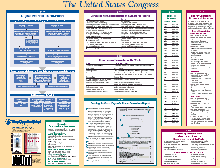
- Congressional Operations Poster
- Federal Budget Links and Research Tools
- Quick DC Links - Washington Essentials
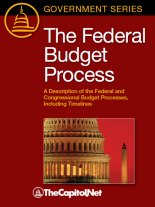
- The Federal Budget Process, Government Series
- The Federal Budget Process by Allen Schick
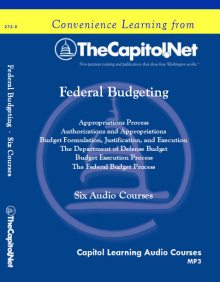
- Capitol Learning Audio Courses: Budget Process TM
- Phone: 202-678-1600
- Email: custom -at- TheCapitol.Net
- Complete our online custom program information request.

URLs: www.TheCapitol.Net/CustomPrograms/acbpagenda.html

LegislativeTraining.com

TheCapitol.Net, Inc.
Contract GS02F0192X
Custom
Training, On-Site and Online
All custom training from TheCapitol.Net is tailored for each organization and audience. Topics from this program can be combined with topics from our other programs and with topics from your existing training programs.
Rave Reviews
See testimonials about this program.See what some of the attendees at our custom programs say about our custom training.
Faculty
Our faculty for this program all have more than 15 years' experience working with the federal budget.
Internal Marketing
To help you publicize and market a custom program to your organization's audience, we can provide printed materials and language for your own internal promotion and publicity.
Our ClientsCongressional OfficesFederal AgenciesMilitaryNGOs and NonprofitsDiplomatic CorpsFortune 500Law FirmsLobbying FirmsLabor UnionsAssociations

The Capitol.Net
The Sunwater Institute
North Bethesda, MD 20852
Phone: 240-753-0941 Email Us
Copyright © 1999-2023 by TheCapitol.Net All Rights Reserved.